Phone:
+86 0319 2296164


Email:
info@lijiresin.cn
In the industrial water treatment sector, the total cost of ownership for ion exchange systems is heavily influenced by the resin for water softener price and its associated operational efficiency. While the initial procurement cost is a primary concern for many facility managers, the real economic value lies in the balance between the resin's exchange capacity and its regeneration frequency.
Understanding the pricing dynamics requires a deep dive into the chemical architecture of the resins. From gel polystyrene structures to highly crosslinked matrices, the material's ability to remove hardness ions directly impacts the volume of regenerant chemicals needed and the lifespan of the resin bed. For engineering teams, a lower upfront price often correlates with a higher long-term operational expenditure if the resin degrades prematurely under chemical stress.
This analysis explores the technical drivers behind resin pricing, the critical specifications that determine value, and how to evaluate the trade-offs between different resin grades to optimize water softening costs.


Most high-performance resins are based on a gel polystyrene structure crosslinked with divinylbenzene. This matrix creates a porous network that allows ions to migrate toward functional groups. In the case of strong base anion resins, the presence of quaternary ammonium groups provides the necessary charge for ion exchange.
The density and uniformity of these beads—typically ranging from 0.315 to 1.25 mm—determine the hydraulic pressure drop across the resin bed. A high whole-bead count (≥95%) is essential to prevent fines from clogging the system, which directly affects the efficiency of the water softening process.
When evaluating the resin for water softener price, engineers must look beyond the cost per liter and focus on the Volume Exchange Capacity. For instance, a capacity of ≥1.5 mmol/ml ensures that more hardness ions are removed per cycle, extending the time between regenerations and reducing the consumption of NaCl or other regenerants.
Water retention capacity (typically between 43% and 47%) is another critical metric. It influences the volumetric expansion of the resin bed during the backwash cycle. If the expansion rate is not correctly calculated, resin overflow can occur, leading to material loss and system failure.
The operating velocity, generally maintained between 2 to 10 BV/h, determines the contact time between the water and the resin. A higher velocity may increase throughput but can lead to premature breakthrough if the resin's kinetic properties are insufficient.
A common challenge in resin selection is the trade-off between initial capacity and long-term structural stability. High-capacity resins often utilize lower crosslinking, which allows for faster ion diffusion but makes the beads more susceptible to osmotic shock during regeneration.
Therefore, the "value" of a resin is not found in the lowest purchase price but in the lowest "cost per cubic meter of treated water." This calculation must include the frequency of resin replacement and the cost of chemical regeneration.
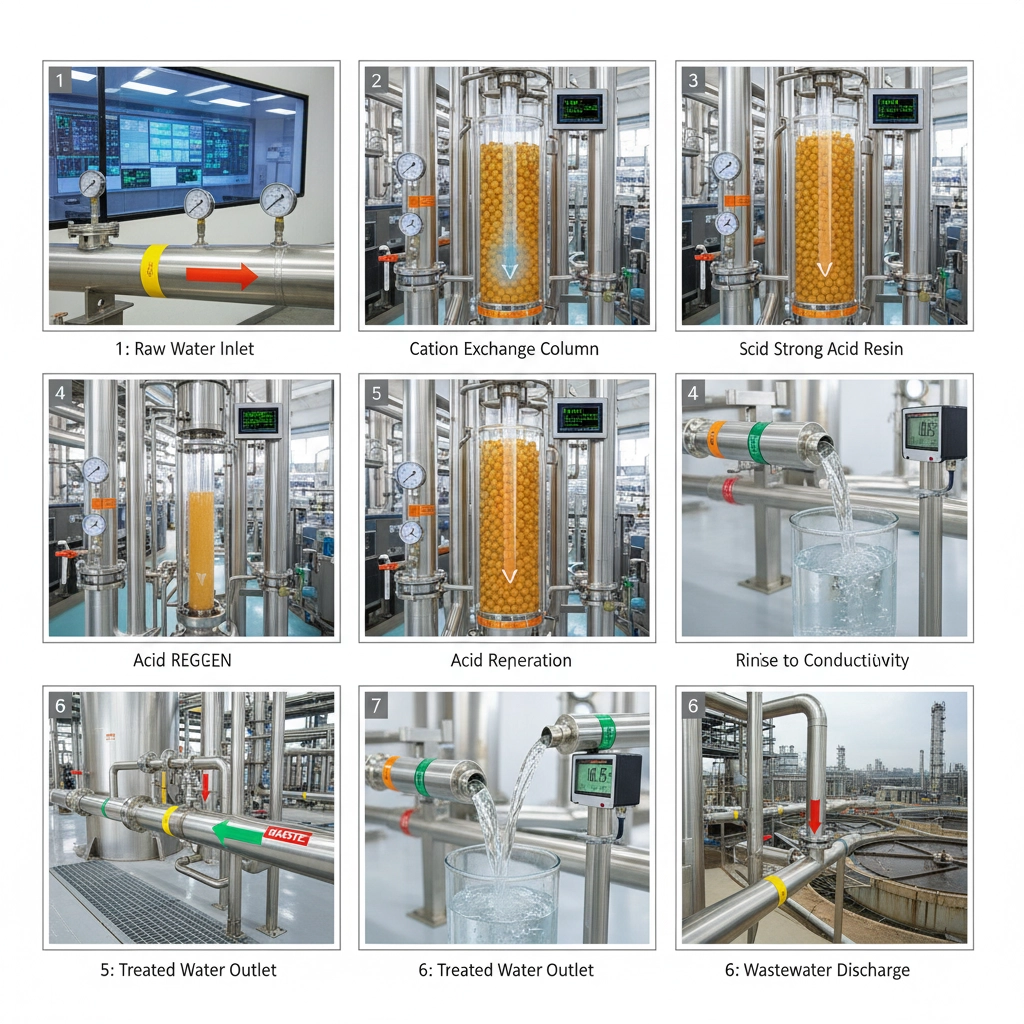
Operational costs are primarily driven by the efficiency of the regeneration cycle. The use of an alkali-water-acid-water flow path is common for high-purity requirements, but the volume of regenerant used is directly proportional to the resin's exchange capacity.
By comparing different resin grades based on a normalized engineering assessment, we can visualize how capacity impacts the overall system rating. Higher capacity typically correlates with lower chemical waste and reduced wastewater discharge.
In a typical industrial deployment, resins are configured in columns with filling heights between 1 and 3 meters. To prevent resin pore jamming, pre-treatment steps such as flocculation, sand filtration, or multi-media filtration are mandatory. These steps ensure that suspended solids do not coat the resin beads, which would otherwise create "channeling" where water bypasses the active exchange sites.
For high-purity water preparation, a three-circulation process before the final ion kernel is often employed. This ensures that the effluent meets strict pharmaceutical or nuclear-grade specifications. In these scenarios, the selection of a resin with a low uniformity coefficient (≤1.6) is paramount to maintain a consistent flow distribution.
The industry is shifting toward "specialized resins" tailored for specific ionic contaminants. While general-purpose resins provide a baseline resin for water softener price, the emergence of chelating and catalytic resins allows for the selective removal of precious metals and specific toxins from complex wastewater streams.
Another significant trend is the development of resins with improved osmotic stability. By optimizing the divinylbenzene crosslinking process, manufacturers are creating beads that can withstand more frequent and aggressive regeneration cycles without losing their spherical shape or capacity.
Furthermore, there is a growing demand for food-grade and pharmaceutical-grade resins that comply with FDA and WQA standards. This requires not only chemical purity but also stringent manufacturing controls to ensure no leachables are present in the treated water.
Selecting the right resin configuration depends on the balance between required water purity and available operational budget. A basic configuration may suffice for general industrial cooling water, whereas a precision configuration is necessary for boiler feed water.
The following matrix provides an engineering framework for comparing different resin profiles. It highlights how specifications like exchange capacity and operating velocity dictate the recommended use case.
It is important to note that these profiles are evaluation guidelines; actual selection should be based on a detailed water analysis and a pilot-scale test of the specific resin's performance in the target environment.
| Configuration Profile | Key Specification | Operating Factor | Recommended Use Case |
|---|---|---|---|
| Basic Profile | Standard Capacity | Low-Mid Velocity | General Softening |
| Standard Profile | ≥1.5 mmol/ml | 2-10 BV/h | Industrial Pre-treatment |
| High-Duty Profile | High Crosslinking | Thermal Stability | High-Temp Process Water |
| Precision Profile | Low Uniformity Coeff. | Strict Flow Control | Pure Water Prep |
| Automated Profile | Consistent Bead Size | Fast Regeneration | PLC-Controlled Systems |
| Industry Baseline | Gel Polystyrene | Standard Regeneration | General Utility Water |
The price is primarily driven by the resin's exchange capacity, the purity of the raw materials (such as the grade of polystyrene and divinylbenzene), and the certifications it holds (e.g., FDA, WQA). High-capacity resins with tight particle size distributions require more precise synthesis and quality control, increasing the cost. However, these typically offer a lower total cost of ownership due to reduced chemical consumption during regeneration.
Volume Exchange Capacity (measured in mmol/ml) defines how many ions the resin can hold per unit of volume. A higher capacity means the resin can treat a larger volume of water before the active sites are saturated. Consequently, the regeneration frequency is reduced, which lowers the amount of salt or acid used and decreases the volume of waste brine produced, improving the overall environmental footprint of the plant.
The Uniformity Coefficient describes the consistency of the bead sizes. A coefficient ≤1.6 indicates a very narrow size distribution. In large industrial columns, this prevents "channeling," where water finds the path of least resistance through larger gaps, bypassing much of the resin. Uniform beads ensure an even flow distribution, maximizing the utilization of the entire resin bed and preventing premature ion breakthrough.
Exceeding the maximum operating temperature (e.g., 100℃ for certain resins) can lead to the degradation of the functional groups or the collapse of the polymer matrix. This results in a permanent loss of exchange capacity and an increase in pressure drop as the beads deform or fragment. Always verify the thermal limits against the manufacturer's technical documentation to avoid catastrophic bed failure.
Resin must be kept in a wet state to prevent the polymer beads from shrinking and cracking. For long-term storage, it is recommended to store the resin in a closed space or immerse it in a salt solution of 5% or higher to inhibit microbial growth. Additionally, the storage environment must be kept above 0℃ to prevent freezing, which can physically shatter the resin beads.
Backwash velocity (typically 4-10 BV/h) is used to loosen the bed and remove trapped particulates. However, if the velocity is too high, the resin beads can be lifted and carried out of the column through the underdrain system. Engineers must balance the need for effective cleaning with the resin's bulk density and water retention expansion rate to prevent material loss.
The procurement of ion exchange materials should not be viewed as a simple commodity purchase. The resin for water softener price is merely a starting point; the true metric of success is the balance between exchange capacity, physical durability, and regeneration efficiency. By prioritizing a high whole-bead count and a low uniformity coefficient, operators can significantly reduce pressure drops and extend the operational life of their water treatment assets.
For facilities targeting high-purity water or treating aggressive wastewater, investing in specialized resin configurations—such as those with enhanced thermal stability and FDA-compliant purity—reduces the risk of system failure and ensures regulatory compliance. The shift toward precision-engineered resins allows for a more sustainable approach to water treatment, minimizing chemical waste and optimizing energy consumption across the entire water cycle.