Industrial Water Softener Resin Price and Performance Guide
Industrial water treatment requires high-precision materials to ensure operational efficiency and equipment longevity. For organizations managing large-scale purification, the selection of ion exchange media is a critical engineering decision. A macroporous strong acid cation resin, characterized by its Styrene-DVB-Copolymer structure and sulfuric acid functional groups, provides the necessary robustness for high-speed mixed bed water treatment and precious metal recycling. Understanding the factors influencing water softener resin price involves analyzing the exchange capacity, particle uniformity, and the specific grade of the material—whether it be industrial, food, pharmaceutical, or nuclear grade.
Hebei Lijiang Biotechnology Co., Ltd specializes in the synthesis of these high-performance polymers. By integrating R&D with advanced manufacturing, the company provides specialized resins tailored to complex fluid dynamics and chemical environments. This guide examines the technical specifications and operational requirements of macroporous resins to help procurement managers and engineers optimize their water treatment investments.

Technical Architecture of Macroporous Strong Acid Cation Resins
The efficacy of a cation exchange resin depends heavily on its physical structure and functional chemistry. This specific resin is engineered as a Styrene-DVB-Copolymer with a macroporous matrix. Unlike gel-type resins, the macroporous structure allows for better accessibility of the functional sulfuric acid groups, making it significantly more resistant to organic fouling and osmotic shock. This structural advantage is vital when dealing with high-speed mixed bed applications where rapid ion exchange and hydraulic stability are paramount.
From a chemical perspective, the resin operates in the Na+ ionic form, ensuring it is ready for immediate deployment in softening or purification cycles. With a weight exchange capacity of ≥4.35 mmol/g and a volume exchange capacity of ≥1.8 mmol/ml, it ensures high throughput with fewer regeneration cycles. The density range (1.25-1.28 g/ml) and a water retention capacity of 45% to 55% provide a balanced equilibrium between active site availability and physical durability during repeated backwashing phases.
- Polymer Base: Styrene-Divinylbenzene (DVB) for mechanical strength.
- Functional Group: Sulfuric Acid for strong acid cation exchange.
- Physical Form: Light brown opaque spherical beads for optimal flow.
- Purity Grades: Available in industrial, food, pharmaceutical, and nuclear grades to meet diverse regulatory standards.

Operational Parameters and Regeneration Logic
To maintain peak performance, the resin must be operated within strict thermodynamic and hydraulic limits. The maximum operating temperature of 120°C allows for use in high-temperature industrial streams without compromising the polymer matrix. For optimal contact time, a resin filling height of 1 to 3 meters is recommended, with operating velocities maintained between 2 to 10 BV/h. Ensuring a uniformity coefficient of ≤1.6 prevents the formation of preferential flow paths (channeling), which would otherwise reduce the effective exchange capacity.
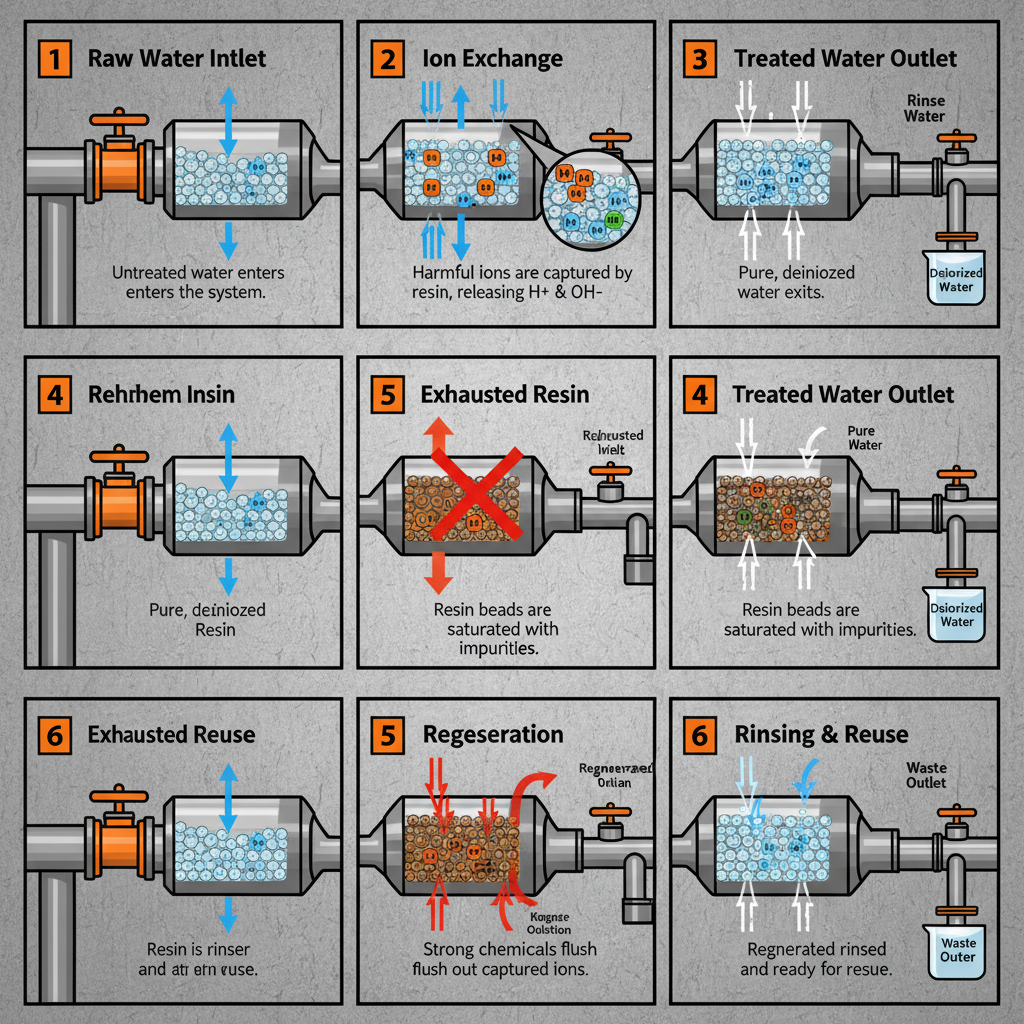
The regeneration process is the most critical aspect of lifecycle management. A typical cycle requires a specific flow path: alkali → water → acid → water. The desorption phase utilizes 3-5% HCl (2BV) followed by 2-4% NaOH (2BV) to restore the active sites. It is essential to account for the expansion rate during these transitions to prevent resin overflow and ensure the liquid level remains stable within the column.
Proper preservation is equally important. Resins should be kept in a wet state, preferably above 0°C. For long-term storage, adding a 5% salt solution prevents the beads from dehydrating or agglomerating, which would otherwise lead to permanent capacity loss and increased pressure drops across the bed.
Industrial Application Scenarios and Buyer Considerations
The versatility of this macroporous resin extends across several high-stakes industries. In high-purity water treatment, it serves as a cornerstone for mixed-bed systems used in semiconductor and pharmaceutical manufacturing. Furthermore, its ability to selectively capture ions makes it ideal for the recycling of precious metals and as an organic catalyst in chemical synthesis. When evaluating the water softener resin price, buyers must look beyond the initial cost and consider the Total Cost of Ownership (TCO), which includes regeneration chemical consumption and the frequency of resin replacement.
Engineers should prioritize pre-treatment steps to protect the resin bed. Implementing flocculation, sand filtration, or multi-media filtration before the liquid enters the resin column is mandatory. This prevents suspended solids from jamming the resin pores, which would otherwise lead to a rapid increase in pressure and a decrease in exchange efficiency. For those requiring custom solutions, Hebei Lijiang Biotechnology provides point-to-point technical support to customize resins for specific blood perfusion or biopharmaceutical extraction needs.
Technical Specification and Performance Matrix
| Property | Specification Value | Testing Standard | Industrial Impact |
|---|---|---|---|
| Exchange Capacity | ≥1.8 mmol/ml (Vol) | Standard Ion Test | Determines cycle length |
| Particle Size | 0.45~1.25 mm (≥95%) | Sieve Analysis | Controls pressure drop |
| Max Temperature | 120°C | Thermal Stability Test | Limits application range |
| Whole Bead Count | ≥95% | Physical Inspection | Prevents fines buildup |
| Bulk Density | 0.77~0.85 g/ml | Gravimetric Method | Influences vessel sizing |
Quality Assurance and Manufacturing Excellence
Consistency in resin performance is a direct result of stringent quality control during the synthesis phase. Hebei Lijiang Biotechnology utilizes a comprehensive management system certified by ISO9001, ensuring that every batch of resin meets the required specifications for capacity and particle distribution. For food-grade and pharmaceutical-grade products, compliance with FDA standards and WQA (Water Quality Association) certifications is maintained to ensure safety and purity in sensitive applications.
The company's R&D center, led by industry experts like Professor Shi Zuoqing, focuses on improving the stability of the Styrene-DVB-Copolymer. By leveraging research platforms with higher education institutions, the company develops resins that can withstand harsher chemical environments while maintaining high selectivity. This commitment to technological innovation allows the manufacturer to offer customized resins that solve specific challenges in nuclear power and rare metal extraction, moving beyond generic commodity resins to high-value engineered materials.
Strategic Procurement and Market Outlook
As global standards for water purity tighten, the demand for high-performance ion exchange media is shifting toward more sustainable and durable options. Buyers are increasingly seeking resins with higher regeneration efficiency to reduce the environmental impact of chemical waste. When sourcing, it is advisable to evaluate suppliers based on their ability to provide technical data sheets (TDS) and material safety data sheets (MSDS) that align with international standards like SGS certification.
Future trends indicate a move toward more specialized resins for the biopharmaceutical and nano-coating sectors. For procurement managers, securing a partnership with a manufacturer that integrates R&D, production, and service—such as Hebei Lijiang Biotechnology—reduces the risk of system failure and ensures a steady supply of certified materials. Focus should remain on balancing the initial investment with the long-term operational savings provided by superior exchange capacities and physical durability.
Frequently Asked Questions About Cation Exchange Resins
What determines the price of water softening resins in bulk?
Costs are primarily driven by the resin grade (industrial vs. nuclear/pharmaceutical), the exchange capacity, and the quality of the polymer base. Macroporous resins generally command a premium over gel resins due to their superior resistance to fouling and physical stability.
How does the macroporous structure differ from gel-type resins?
Macroporous resins have a permanent pore structure that allows larger molecules to access internal exchange sites. This makes them more suitable for high-speed applications and environments with organic contaminants, whereas gel resins are more common in simple softening.
What is the ideal regeneration cycle for this specific resin?
The recommended flow path is alkali-water-acid-water. Specifically, use 2BV of 3-5% HCl for desorption and 2BV of 2-4% NaOH for conditioning to ensure the functional sulfuric acid groups are fully restored.
Can this resin be used in food and beverage production?
Yes, provided you select the food-grade variant. Hebei Lijiang Biotechnology produces resins that comply with FDA standards and hold national food hygiene licenses, making them safe for pharmaceutical and food-grade applications.
What are the risks of improper resin storage?
If resins dry out or freeze, the beads can crack or collapse, leading to a permanent loss of exchange capacity and the creation of "fines" that clog the filter bed. Always store resins in a wet state with a salt solution if not in use.
How do I prevent the resin column from jamming?
Always implement pre-treatment steps such as sand filtration or flocculation. This removes suspended solids before they reach the resin, ensuring the pores remain open for ion exchange and preventing premature pressure increases.
Technical References and Industry Standards
- Principles of Water Softening and Ion Exchange
- ISO 9001 Quality Management Systems for Manufacturing
- FDA Standards for Food Contact Substances
- Water Quality Association (WQA) Certification Standards
Selecting the right ion exchange media is a balance of technical specification and economic viability. By focusing on high-capacity macroporous resins and adhering to strict operational protocols, industrial users can ensure consistent water quality and optimize their overall processing costs.
Related Articles